

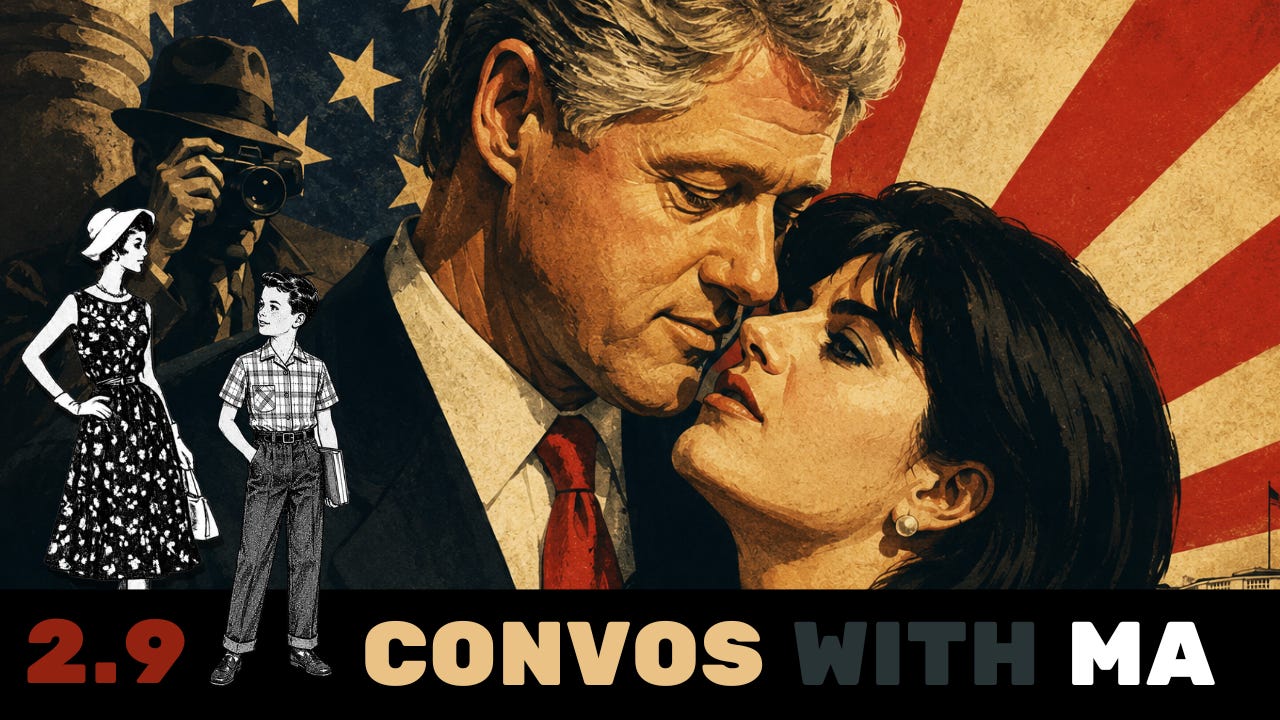
A lot of folks don’t realize they were in love. Sure, they pointed at a dress, but a black light revealed they were all over The Oval Office. They had to replace the desk becausae one of the edges had begun to warp. I mean, that girl was wet.
Segment 1: The August 17 Climax
The Setting: August 17, 1998, in Washington, D.C. The city is overwhelmed by intense media presence as President Bill Clinton prepares for a historic legal hurdle.
The Legal Stakes: For the first time in history, a sitting president is scheduled to give testimony before a federal grand jury as the specific target of an investigation into his personal conduct.
The Anticipation: Sixty-seven million citizens are waiting for a scheduled 10:00 PM televised address from the Oval Office following the testimony.
Segment 2: The Intern’s Arrival (Summer 1995)
Who is Monica Lewinsky: A 21-year-old recent college graduate from California who moves to Washington, D.C.
Her Role: She secures a prestigious, unpaid internship in the White House office of Chief of Staff Leon Panetta.
The Context: She initially works in the Old Executive Office Building handling basic clerical tasks like sorting mail, but she frequently observes the President at official functions, sparking a mutual, silent flirtation.
Segment 3: The Government Shutdown (November 1995)
The Political Context: A bitter budget dispute between President Clinton and the Republican-led Congress causes a federal government shutdown.
The Impact on Staffing: Non-essential White House staff members are furloughed and sent home, leaving unpaid interns like Lewinsky to work directly inside the West Wing to keep the executive branch running.
The First Encounter: On November 15, 1995, inside an largely empty West Wing, the casual flirtation escalates into their first private, intimate encounter.
Segment 4: The Secret West Wing Relationship (1995–1996)
The Dynamics: Over the course of several months, the President and the intern carry out a series of highly secretive, sporadic encounters inside the Oval Office suite.
The Exchange of Gifts: To keep the connection private, they exchange gifts; Lewinsky gives Clinton ties, while he gives her personal items, including a hat pin and a copy of the book Leaves of Grass.
The Power Asymmetry: The relationship is defined by an extreme power imbalance, with encounters frequently interrupted by the literal business of the presidency, such as Clinton taking official calls from lawmakers mid-encounter.
Segment 5: The Pentagon Exile (April 1996)
Staff Intervention: Senior White House aides notice that Lewinsky is spending an unusual amount of time hovering near the Oval Office after hours.
The Transfer: Fearing a political scandal during a high-stakes presidential re-election year, aides abruptly remove Lewinsky from her White House job and transfer her to a public affairs role at the Pentagon.
The Continued Contact: Though their physical proximity ends, the relationship transforms into emotional dependency, with the two staying in contact via late-night phone calls.
Segment 6: The Confidante and the Tapes (1997)
The New Friendship: Isolated at the Pentagon, Lewinsky becomes close friends with a coworker named Linda Tripp.
The Shared Secret: Over several months, Lewinsky pours her heart out to Tripp, detailing her ongoing obsession and history with the President.
The Betrayal: Skeptical of the situation and looking to protect herself, Tripp secretly attaches a recording device to her home phone, capturing hours of Lewinsky describing the intimate details of the affair.
Segment 7: The Finger-Wagging Denial (January 1998)
The Leak: Linda Tripp hands the secret recordings over to federal investigators, and the story breaks in the national news, throwing the presidency into immediate crisis.
The Public Stance: On January 26, 1998, standing alongside First Lady Hillary Clinton, President Clinton delivers a fierce public statement from the Roosevelt Room.
The Nine Words: He looks into the camera, wags his finger, and states: “I did not have sexual relations with that woman.” This forces his entire administration to spend months aggressively defending a lie.
Segment 8: The Forensic Turning Point (July 1998)
The Immunity Deal: Facing immense legal pressure and potential charges for lying under oath, Monica Lewinsky signs an absolute immunity agreement with prosecutors.
The Physical Evidence: Lewinsky surrenders a specific blue dress from her closet that contains physical DNA evidence of the relationship.
The Legal Trap: This forensic breakthrough instantly destroys the White House strategy of total denial, forcing the President’s legal team to advise him that he must change his story.
Segment 9: Four Hours in the Map Room (August 17, 1998)
The Closed-Door Testimony: Clinton sits down in the White House Map Room before a closed-circuit camera to testify under oath to a grand jury sitting across town.
The Questioning: For four grueling hours, federal prosecutors subject the President to deeply personal, explicit questioning regarding the mechanics of his encounters with Lewinsky.
The Speechwriter Crisis: Upstairs in the West Wing, speechwriters spend the afternoon in fierce arguments, debating how much the President should confess and whether he should apologize or attack his political enemies in his upcoming address.
Segment 10: The Admission and Historical Legacy
The Prime-Time Address: At 10:00 PM, Clinton addresses 67 million viewers, admitting the relationship was “not appropriate” and “wrong,” reversing his January denial.
The Political Consequences: The speech fails to defuse the anger, leading directly to his historic impeachment by the House of Representatives later that year.
The Modern Lens: Decades later, historical evaluation of the event has shifted from a debate over legalities and political survival to a modern discussion centered on workplace power dynamics, accountability, and consent.
I enjoyed listening to you.