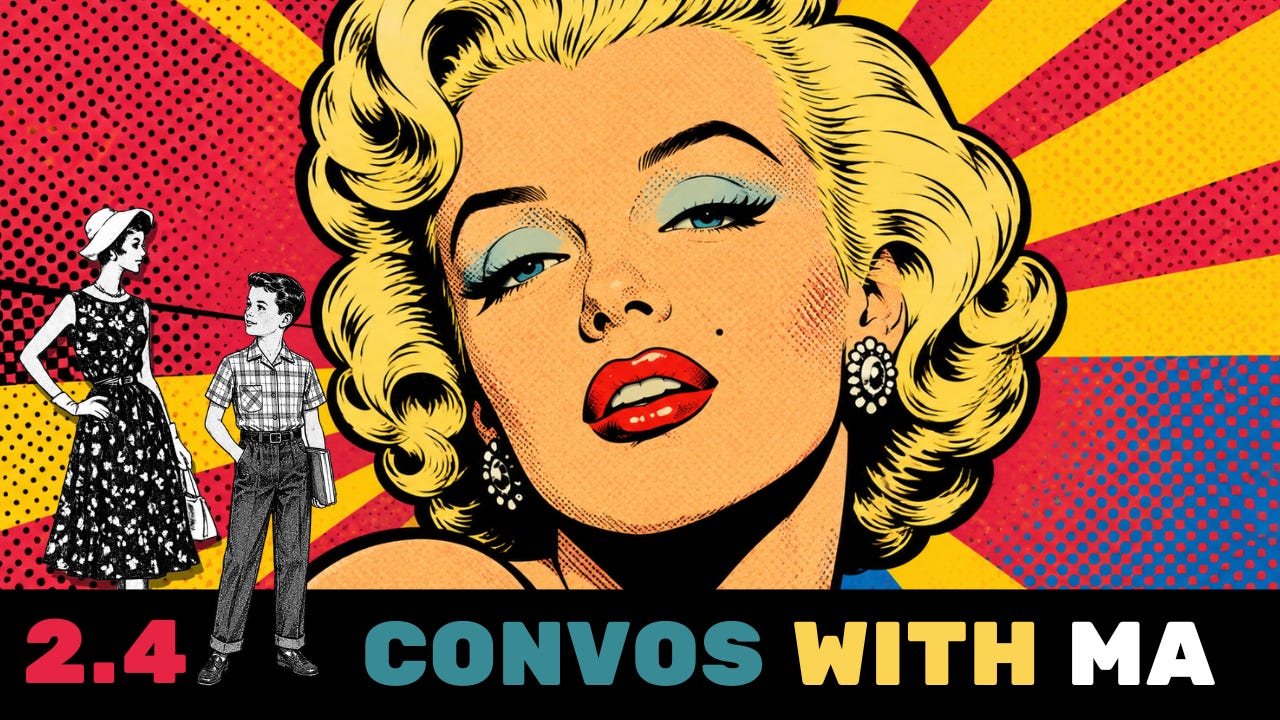
Marilyn Monroe - August 5, 1962
Segment 1 - The Discovery
The official story begins.
August 5, 1962: Marilyn Monroe is found dead in her Brentwood, California home at age 36.
Around 3 a.m., housekeeper Eunice Murray notices a light under Marilyn’s bedroom door. She knocks, but gets no response. The door is locked.
Murray calls Marilyn’s psychiatrist, Dr. Ralph Greenson, who lives nearby. He breaks a window to enter the bedroom.
Marilyn is found face down on her bed, nude, with a telephone nearby. Empty prescription pill bottles are found in the room.
The Los Angeles Police Department rules her death a probable suicide caused by an overdose of sleeping pills.
Discussion: The official explanation seems straightforward, but the final 24 hours raise plenty of questions.
Segment 2 - The Last Day
What happened in Marilyn’s final hours?
Earlier that day, Marilyn accepts delivery of a bedside table and citrus trees for her home, hardly the actions of someone putting their affairs in order.
She reportedly argues with her friend and publicist, Pat Newcomb. Some say it was about Marilyn’s health, while others believe it involved Newcomb’s connections to the Kennedy family.
Around 7 p.m., former stepson Joe DiMaggio Jr. calls and later says Marilyn sounded cheerful and upbeat.
About 30 minutes later, actor Peter Lawford calls to invite her to dinner. He says her speech is slurred and difficult to understand.
Before hanging up, Marilyn reportedly says, “Say goodbye to Pat, say goodbye to the President, and say goodbye to yourself, because you’re a nice guy.”
Discussion: Was this simply the effect of medication, or something more significant?
Segment 3 - Everything Was Falling Apart
Her personal and professional life had become increasingly unstable.
Just weeks before her death, 20th Century Fox fires Marilyn from Something’s Got to Give because of repeated absences from filming.
The studio points to chronic lateness and illness, while others blame her growing dependence on prescription medication.
Losing the role is a public embarrassment for the world’s biggest movie star and creates uncertainty about her future.
Marilyn had also become increasingly isolated, relying heavily on doctors, psychiatrists, and close friends.
Discussion: How much pressure can one person absorb before everything begins to unravel?
Segment 4 - The Kennedy Question
The connection everyone has heard about.
Marilyn had documented relationships with both President John F. Kennedy and his brother, Robert Kennedy.
Peter Lawford, the man who spoke to Marilyn on her final evening, was married into the Kennedy family.
Her comment about “the President” has become one of the most quoted lines in the entire case.
Over the years, confirmed relationships have been mixed together with rumors and conspiracy theories.
Discussion: Where should we draw the line between documented history and speculation?
Segment 5 - Reasonable Doubt
Why do some people reject the suicide ruling?
Critics point to unexplained bruising, missing phone records, and the delay before police were called.
These unanswered questions have fueled conspiracy theories for more than sixty years.
In 1982, the Los Angeles County District Attorney reviewed the case looking for evidence of murder.
After reviewing the available evidence, investigators upheld the original conclusion of probable suicide.
Discussion: Can a case have unanswered questions without being a conspiracy?
Segment 6 - Norma Jeane
Before there was Marilyn Monroe.
Born Norma Jeane Mortenson in 1926, she spent much of her childhood in foster homes and an orphanage after her mother struggled with mental illness.
She married at 16 before eventually discovering modeling during World War II.
In 1946, she signed with 20th Century Fox and became “Marilyn Monroe.”
Behind one of the world’s most famous faces was someone who spent much of her life searching for stability and acceptance.
Discussion: How much of Marilyn Monroe was real, and how much was Hollywood’s creation?
Segment 7 - The Body as Icon
When the person became the symbol.
Within weeks of Marilyn’s death, artist Andy Warhol began producing his famous Marilyn silkscreen portraits.
Her image quickly became one of the most recognizable pieces of pop art in the world.
The smiling blonde face became a commercial symbol that often overshadowed the complicated woman behind it.
Few celebrities have had their image transformed into art so quickly after their death.
Discussion: Did the icon replace the person?
Segment 8 - Hollywood’s Open Secret
Marilyn’s story wasn’t unique.
The old Hollywood studio system tightly controlled actors’ appearances, schedules, and public image.
Prescription drugs were common, and many studios quietly ignored or enabled addiction if it kept productions moving.
Once Marilyn became unreliable, the same industry that made her famous quickly distanced itself.
Her story reflects broader problems that affected many stars of the era.
Discussion: Was Marilyn failed by Hollywood, or was she simply one of many victims of the system?
Segment 9 - The First Modern Celebrity Myth
Did Marilyn Monroe become the blueprint for the modern celebrity legend?
Books questioning the official suicide ruling began appearing almost immediately after her death. Many offered conflicting theories, but they helped turn the case into an enduring mystery.
Television documentaries have revisited Marilyn’s death for decades, often promising “new evidence” or a fresh suspect, even when little had actually changed.
The FBI kept a file on Marilyn because of her connections to politically influential people during the Cold War. When those files became public years later, they fueled even more speculation.
In 2022, Netflix’s Blonde introduced Marilyn to a new generation. Although fictional, many viewers assumed it was historically accurate, showing how easily myth and fact become intertwined.
Discussion: Did Marilyn Monroe become more famous after she died than while she was alive?
Segment 10 - August 5th
Why does August 5th still belong to Marilyn Monroe?
Every August 5th, newspapers, documentaries, podcasts, and websites revisit her death, keeping the story alive more than six decades later.
Marilyn memorabilia remains incredibly valuable. In 2016, the dress she wore while singing “Happy Birthday” to President Kennedy sold for nearly $5 million.
Even people who have never seen one of her movies recognize her image. The white dress, platinum blonde hair, and iconic photographs have become part of popular culture.
Her story touches on fame, mental health, politics, Hollywood, and conspiracy theories, giving every generation a different reason to revisit it.
Closing Discussion: Are we remembering Marilyn Monroe the woman, or Marilyn Monroe the legend?