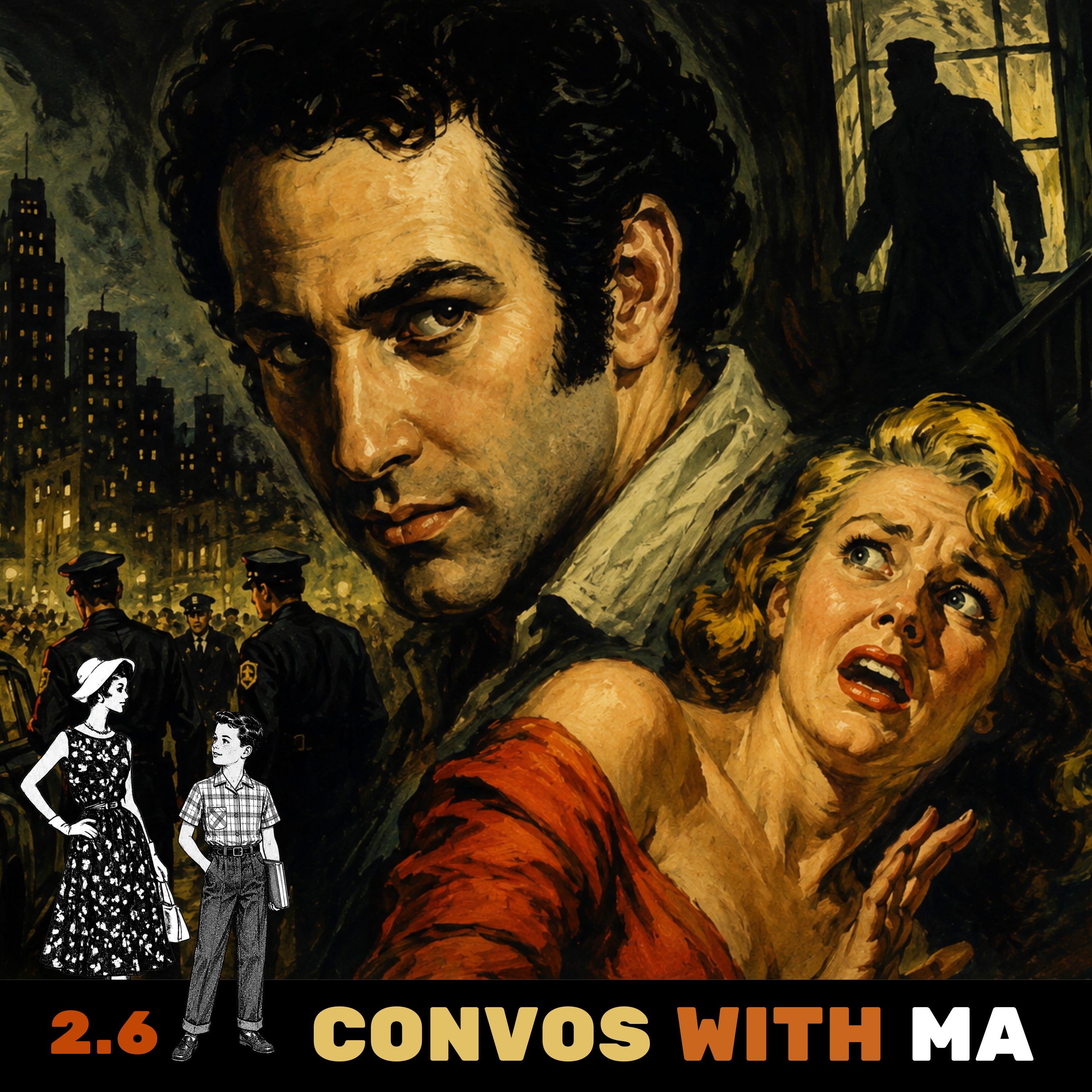
We got the dates mixed up a little. Sonny was caught today, August 10th. We were tricked by our assistant by quoting it as July 31st, which was the final murder of Berkowitz. Our bad. It doesn’t lessen the episode.
Also, Ma went off on a side tangent at the end of the episode, which was edited out by her request. Hilareous and cynical, it was. But, as she softened her outlook by the afternoon hours, she said, “Get rid od that end part.” Done.
Enjoy the episode!
1. The Historical Event: The Son of Sam Is Caught
1. The Historical Event: The Son of Sam Is Caught
What happened: On July 31, 1977, New York City police arrested David Berkowitz, a 24-year-old postal worker, outside his apartment in Yonkers, New York. His arrest ended a year-long killing spree and one of the most intense manhunts in New York City history.
Between July 1976 and July 1977, Berkowitz shot 13 people, killing six. His victims were often young people sitting in or near parked cars, and he attacked without an obvious personal connection to them. That randomness terrified New Yorkers.
The killer became known as “Son of Sam” because he claimed that a neighbor’s dog, possessed by a demon named Sam, had ordered him to kill. He also sent bizarre letters to police and newspapers, taunting investigators and turning the case into a media circus.
The break came after a shooting in Brooklyn on July 31, 1977. Police discovered that the killer’s car had received a parking ticket near the scene. Investigators traced the vehicle to Berkowitz.
Police went to his Yonkers apartment. Berkowitz was arrested as he emerged from the building, carrying a .44-caliber revolver.
The big narrative question: How did one guy manage to terrorize New York City for a year, leave behind clues, communicate with the police, and still remain at large?
2. Welcome to 1970s New York, Where Everyone Is Already Freaking Out
Before getting into Berkowitz, establish the city he was hunting in.
New York in the late 1970s was dealing with crime, fiscal problems, blackouts, crumbling infrastructure, and a general sense that the city was coming apart at the seams. Then somebody starts randomly shooting people in parked cars.
There was no internet, no smartphones, no social media alerts. Information moved through television, newspapers, radio, and word of mouth.
That matters enormously.
Imagine hearing that a killer is somewhere in New York, targeting apparently random couples, and the police cannot tell you where he will strike next.
Then imagine having to wait until tomorrow’s newspaper to find out what happened.
Podcast angle: The city itself becomes a character. New York is not merely the setting. It is an increasingly paranoid participant in the story.
3. Who the Hell Was Son of Sam?
Now introduce Berkowitz properly.
David Berkowitz was born in 1953 and adopted as an infant. He grew up in the Bronx and later moved to Yonkers. He served briefly in the U.S. Army and eventually worked as a postal employee.
He was socially isolated and had a history of emotional and behavioral problems. In 1975, he began committing arson, setting dozens of fires.
Then came the shootings.
His first known attack occurred in July 1976, when he shot two teenage girls in the Bronx, killing one. Over the following year, he continued attacking people, eventually killing six and wounding seven.
But Berkowitz did not simply shoot people.
He created a persona.
Son of Sam sounded less like a human being and more like some supernatural entity stalking New York.
That was extremely useful for generating terror.
4. The Letters: Congratulations, You Are Now in a Conversation With the Killer
This is where the story gets wonderfully weird.
Berkowitz sent letters to police and newspapers mocking investigators and describing himself as “Son of Sam.” One particularly famous letter was addressed to New York Daily News columnist Jimmy Breslin.
The letters turned the investigation into a public performance.
Suddenly, the killer was not just committing crimes. He was communicating with the city.
The press eagerly covered the messages, and the nickname “Son of Sam” became nationally famous.
You can explore the uncomfortable question here:
When a murderer deliberately creates a media persona, how much does the press accidentally help him build it?
The newspapers needed the story. The killer wanted attention. The police wanted information. The public wanted answers.
Everyone was feeding the same machine.
5. New York Goes Full Detective Mode
This is your crowd-participation segment.
Once the shootings became a major story, ordinary New Yorkers began looking for the killer themselves.
People reported suspicious cars. They called police with tips. Rumors spread. People speculated about what the killer looked like and who he might be.
Police investigators were drowning in information.
And there is a delicious historical lesson here:
Having too many clues can be almost as bad as having none.
Thousands of tips had to be investigated. Detectives were trying to determine which details mattered and which were simply frightened New Yorkers seeing monsters everywhere.
You can talk about how modern audiences tend to imagine police investigations as neat chains of evidence.
Real investigations are often more like dumping 10,000 puzzle pieces onto the floor and discovering that 9,700 belong to different puzzles.
6. The Parking Ticket That Helped Catch Him
This should be the “wait, that’s what finally cracked it?” segment.
After Berkowitz’s final shooting on July 31, investigators discovered that a witness had seen a suspicious yellow Ford Galaxie near the scene.
More importantly, the car had been ticketed for a parking violation.
That mundane little piece of bureaucracy suddenly became extremely important.
Investigators traced the ticket and identified the vehicle’s owner, Berkowitz.
Police connected him to the case and moved quickly.
The irony is fantastic:
After months of manhunts, psychological profiles, frantic tips, newspaper coverage, and nationwide fear, one of the crucial breadcrumbs was essentially:
“This guy parked badly.”
That gives you a fun opportunity to contrast cinematic detective work with the boring administrative details that can actually solve crimes.
7. The Arrest: And Then There Was Just... David?
Police arrested Berkowitz outside his Yonkers apartment on July 31.
According to accounts of the arrest, he was found with a .44-caliber revolver and reportedly did not put up a significant struggle.
And this creates an important psychological whiplash for the audience.
For months, New Yorkers had imagined Son of Sam as this almost mythological monster.
Then police caught him.
He wasn’t a demon.
He wasn’t a shadowy mastermind.
He was a 24-year-old man standing outside an apartment building.
That transition from terrifying legend to ordinary human being is one of the most interesting parts of the story.
Podcast question: What happens to a monster story when you finally put a face on the monster?
8. Wait, What About the Demon Dog?
Now go into the strangest part.
Berkowitz told investigators that his neighbor’s black Labrador retriever, owned by a man named Sam Carr, was possessed by a demon and had commanded him to kill.
Hence “Son of Sam.”
This immediately became one of the most famous bizarre elements of the case.
But this is where the podcast can become more sophisticated than simply laughing at the story.
Was Berkowitz genuinely experiencing delusions? Was the demon story an excuse? Was it partly theatrical? How did his mental state interact with his desire for notoriety?
And later, Berkowitz changed parts of his story and eventually acknowledged that the “demonic dog” explanation was not the whole truth.
That gives you a larger question:
How much of a serial killer’s mythology comes from the killer, and how much comes from everyone else trying to explain him?
9. The Son of Sam Law, Because Apparently We Needed to Debate Whether Murderers Get Royalties
Now jump from the killer to the aftermath.
Berkowitz became internationally notorious almost overnight. There was concern that criminals could potentially profit from selling their stories to publishers, filmmakers, or others.
New York responded with legislation commonly known as the Son of Sam law, designed to prevent criminals from profiting from the publicity surrounding their crimes.
And suddenly the story isn’t just about murder.
It’s about:
freedom of speech
victims’ rights
sensationalism
true crime
celebrity
the economics of notoriety
This is a fantastic bridge to modern true crime.
Because today we live in a world where a notorious criminal can become the subject of documentaries, podcasts, books, television series, interviews, and endless online discussion.
The Son of Sam case was an early warning that fame itself can become part of the punishment, the reward, and the problem.
10. The Final Twist: What Did We Actually Capture?
End by stepping back from the arrest.
The police caught David Berkowitz. He confessed to the shootings and was sentenced to six consecutive 25-years-to-life terms.
But the larger story is about something harder to capture: fear.
For a year, New Yorkers did not know where the next attack would happen. A city of millions became obsessed with a killer who seemed able to strike randomly.
Berkowitz’s capture restored a sense of order.
But the story also demonstrated how quickly a person can become a legend, how fear can distort perception, and how media attention can transform a criminal case into a cultural phenomenon.
And there is a particularly good closing thought for an irreverent podcast:
The Son of Sam manhunt ended when police arrested a guy because somebody noticed he had gotten a parking ticket.
After all the demonic dogs, threatening letters, terrified teenagers, newspaper hysteria, police sketches, thousands of tips, and one of the biggest manhunts in New York history, bureaucracy quietly helped close the case.
The city was looking for a monster.
It found a guy with a gun and a bad parking habit.